SOLUTIONS / DATA CENTER INTERCONNECTION
Data center interconnection with a battery.
For most data center projects, the interconnection date sets the schedule. Grid operators now ask large loads to ride through faults, limit power variation and ramp at a permitted rate. A battery on the site's medium-voltage bus, in series with the load or beside it, addresses those conditions in the interconnection study and can move an approval forward.
01 / SCHEDULE RISK
The interconnection sets the schedule.
Grid operators require large computational loads to demonstrate ride-through capability before they connect. In ERCOT, NOGRR 282, in force since August 1, 2026, sets voltage and frequency ride-through requirements for large computational loads: under NPRR 1308, sites of 75 MW and above where at least half the demand is computational load. Utilities add ramp and variability limits in the interconnection agreement, and ERCOT has proposed a 10 MW in 5 seconds power-variation limit. A site that arrives with a battery already in the power design, and a simulation showing it meets each condition, has fewer open questions in the study and a shorter path to approval.
The NOGRR 282 ride-through page shows the fault case. The power smoothing page shows the variation limit at 120 MW and 1 GW.
02 / RAMP RATE
Training starts at the permitted pace.
Ramp rate control limits the change in net site load in both directions, in configurable megawatts per minute, at each feeder and at the point of interconnection. When a training job starts or a site moves onto its generators, the load changes in seconds. The battery covers the difference while the grid draw moves at the agreed rate, then recharges within the same limits.
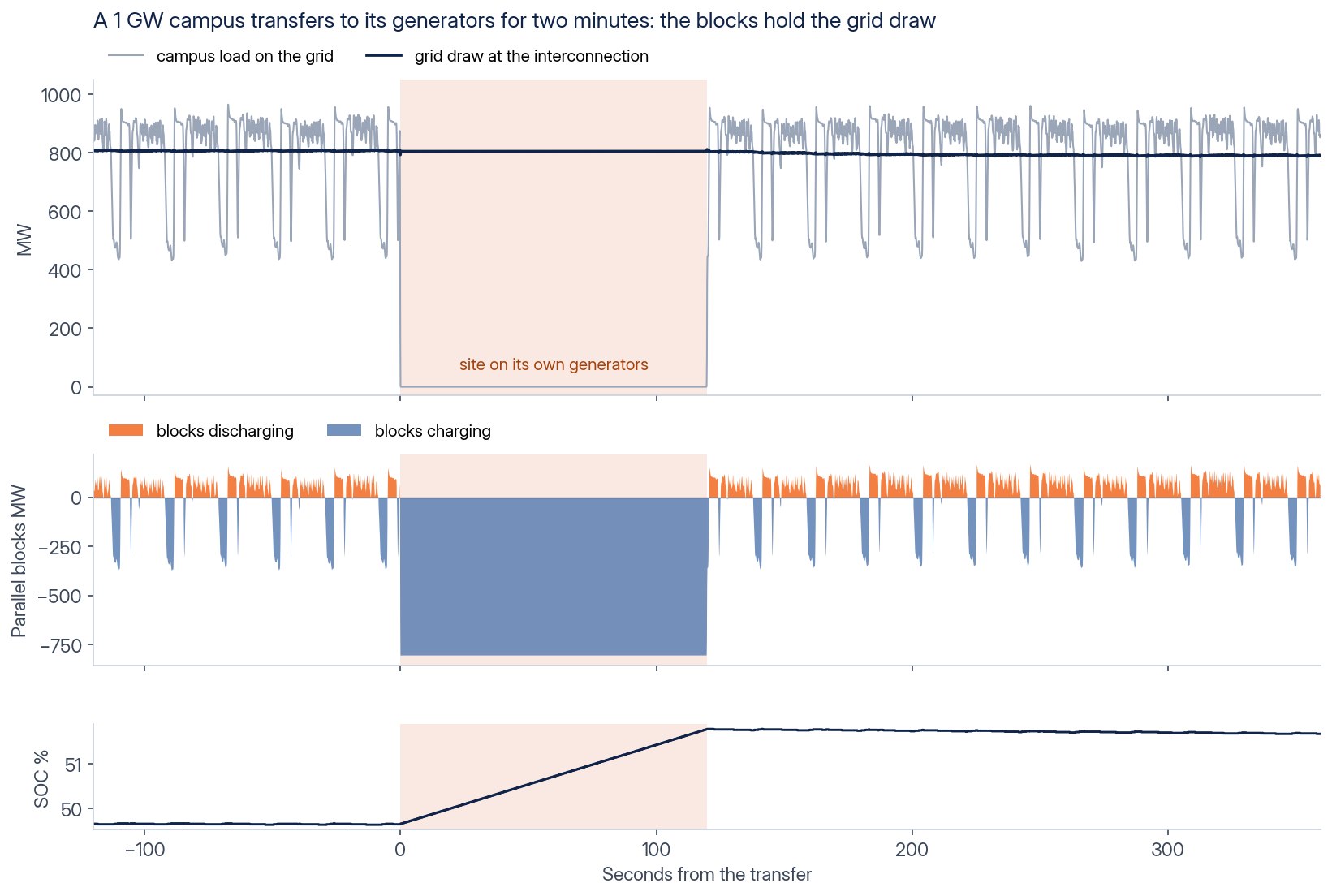
Ramp rate control also protects on-site generation on the medium-voltage bus. Reciprocating engines cannot ramp fast enough for AI loads and gas turbines are slower still. The battery handles the rate of change that the generators cannot.
03 / LIMITED GRID AND ON-SITE GENERATION
One EMS for the grid connection and the generators.
Increasingly, data centers supplement a limited grid connection with on-site generation. Battalion EMS optimizes the power flows across the grid connection, the generators and the battery: it holds the interconnection limits, dispatches generation when the load exceeds the connection, and minimizes battery wear while doing it. The same controller runs the smoothing and ride-through functions, so there is one set of priorities for the site rather than three devices arguing.
Where the connection allows it, the battery also earns against the bill: four coincident peak (4CP) and five coincident peak (5CP) charges, energy price spikes, demand response and wholesale market services. Those are covered on the coincident peak programs and behind-the-meter pages.
04 / WHAT TO BRING
Diagram, load profile, agreement.
A first conversation needs the single-line diagram, the load profile with its time resolution, and the interconnection agreement or the utility’s draft conditions. From those we simulate the site at the resolution the rule needs, 1 ms for ride-through and power variation, and return the connection options with the battery power and energy each one needs. Request information to start.YOUR PROJECT
Request information
Tell us what you are evaluating. An engineer will review your request.
Request information
Request received.
An engineer reviews every request and replies to approved company addresses within one business day.
Your email draft is ready. Send it to complete your request. If your mail client did not open, open the request email or email contact@battalion.energy from your company address with the same details.