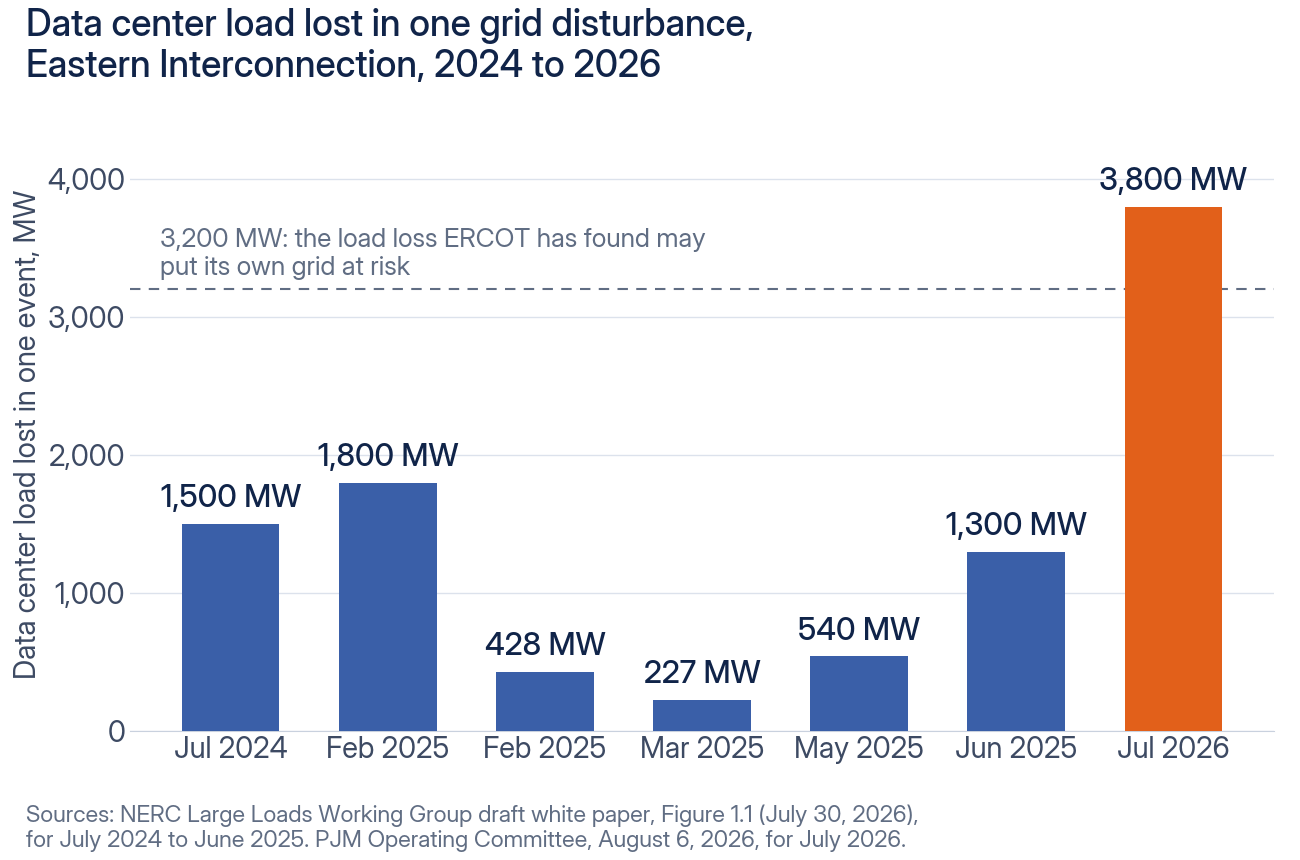
On July 22, 2026, at 7:56 in the morning, a 230 kV transmission line in Northern Virginia faulted. The protection cleared it as designed. Within about a minute, approximately 3,800 MW of data center load had moved off the grid and onto backup power, the largest load transfer PJM has recorded. PJM had seen similar events in the same area in July 2024 and February 2025, and this one was about twice as large.
ERCOT has written the answer into its rules. Nodal Operating Guide Revision Request (NOGRR) 282, approved by the Public Utility Commission of Texas on July 9, 2026 and in force since August 1, 2026, requires large computational loads to stay connected through defined voltage and frequency disturbances and to return to the grid within seconds. The event reports from NERC, PJM and ERCOT explain why the rule is written the way it is, and why it matters for the tens of gigawatts of data centers now waiting to connect.
What happens when a data center leaves the grid
A data center protects its computers with an uninterruptible power supply (UPS). When grid voltage dips, the UPS carries the load from its batteries, or a flywheel carries it until a diesel engine starts. That is correct behavior for the building. For the grid, the result is a sudden loss of load at the moment of a fault.
A grid is planned to survive the sudden loss of its largest generator. It has not been planned for the sudden loss of gigawatts of load. When load disappears, the generators that were serving it speed up, so frequency rises. Less current flows through the lines, so voltage rises. NERC’s review of the 2024 event describes both effects, and the July 2026 event showed what follows: the voltage rise itself pushed a second wave of data centers off the grid.
The second problem is that much of the load does not come back on its own. NERC describes three load behaviors seen in 2024. A static UPS rides on its batteries and returns to the grid within seconds. A diesel rotary UPS (DRUPS) starts its engine and usually stays on it until an operator transfers it back by hand. And many sites run a counting scheme: three voltage dips within about one minute send the load to backup, where it stays until someone manually reconnects it.
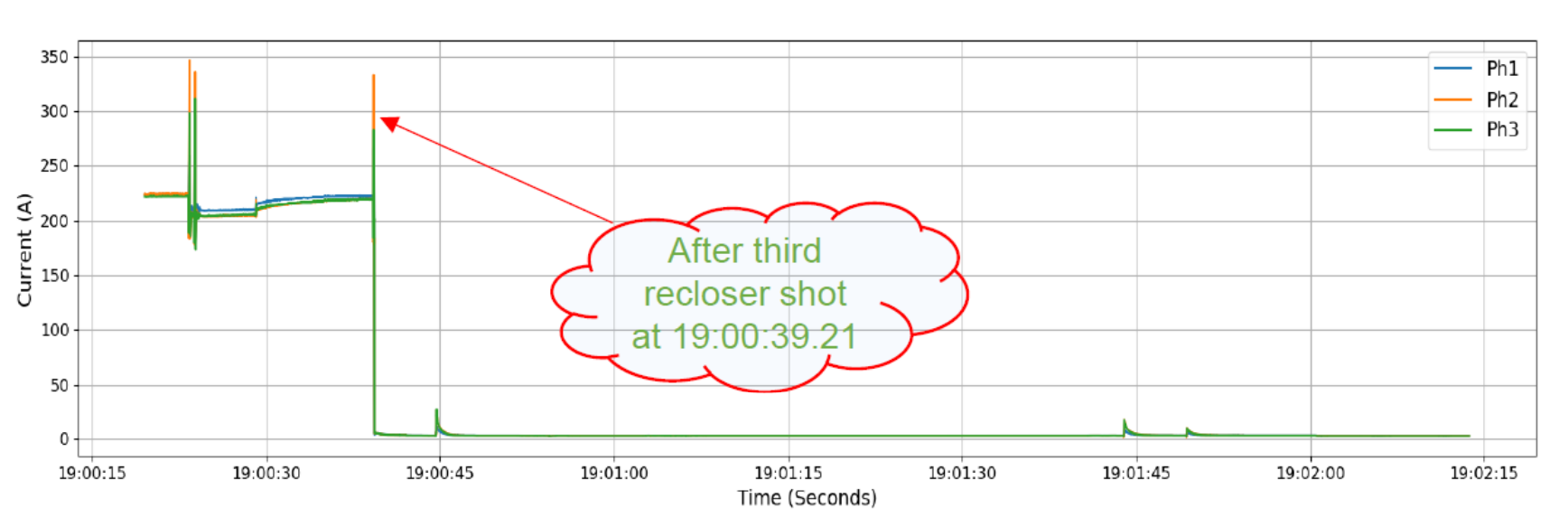
July 10, 2024: six faults in 82 seconds, 1,500 MW gone
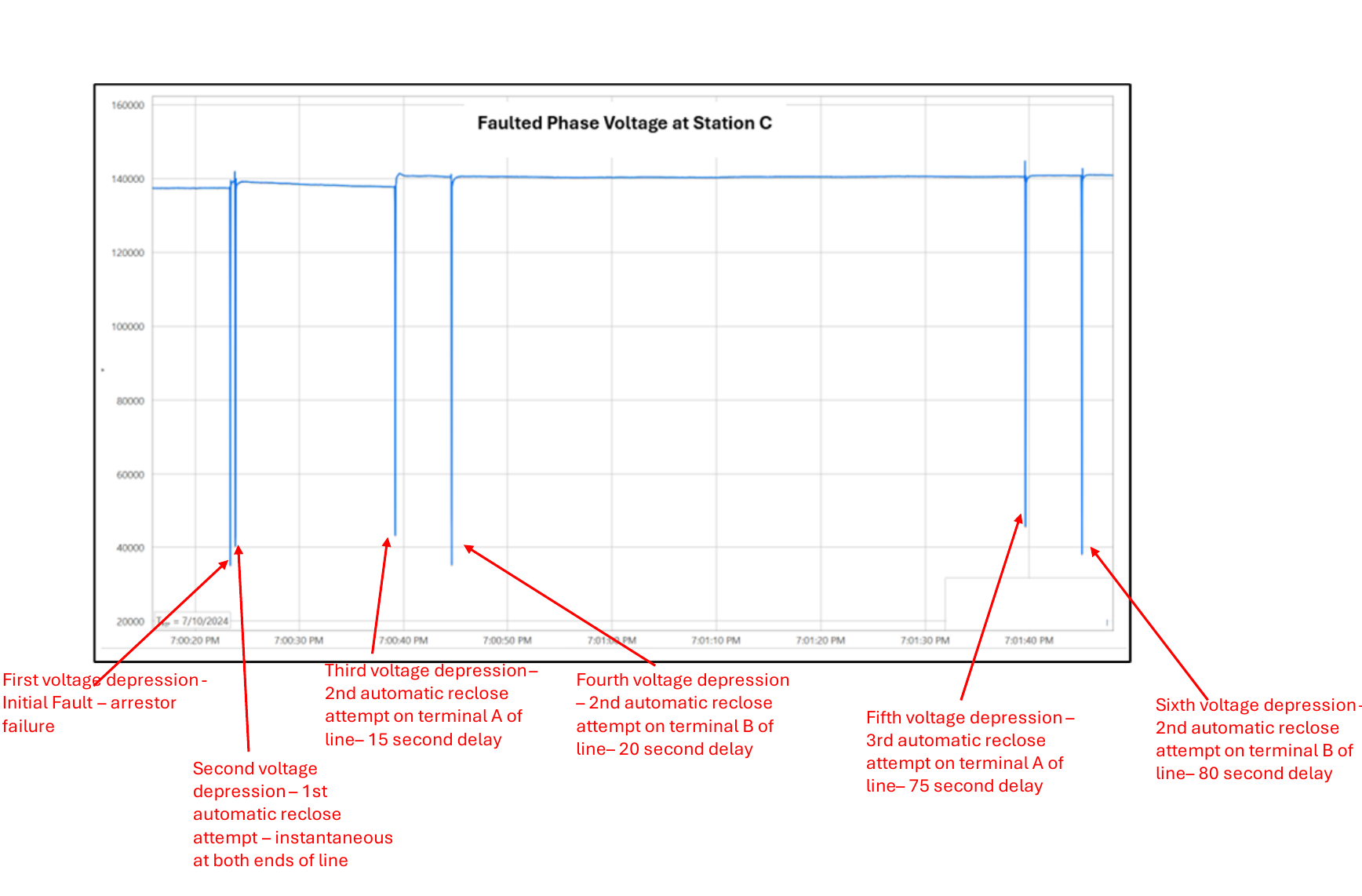
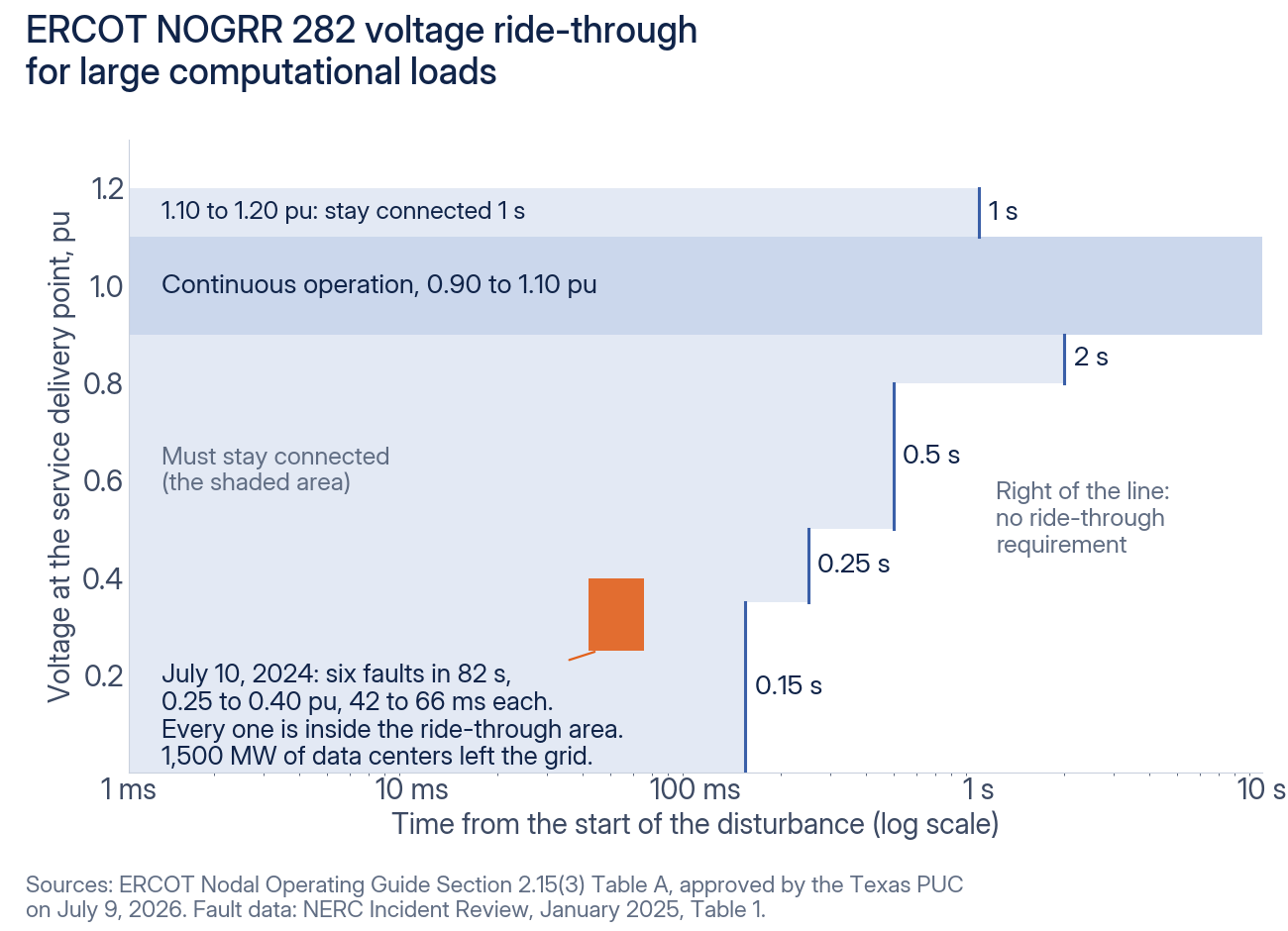
A lightning arrester failed on a 230 kV line at about 7:00 p.m. The line’s automatic reclosing was set for three attempts at each end, so the system saw six faults in 82 seconds. Each was cleared correctly, in 42 to 66 milliseconds, with voltage in the area falling to 0.25 to 0.40 per unit (25 to 40 percent of normal).
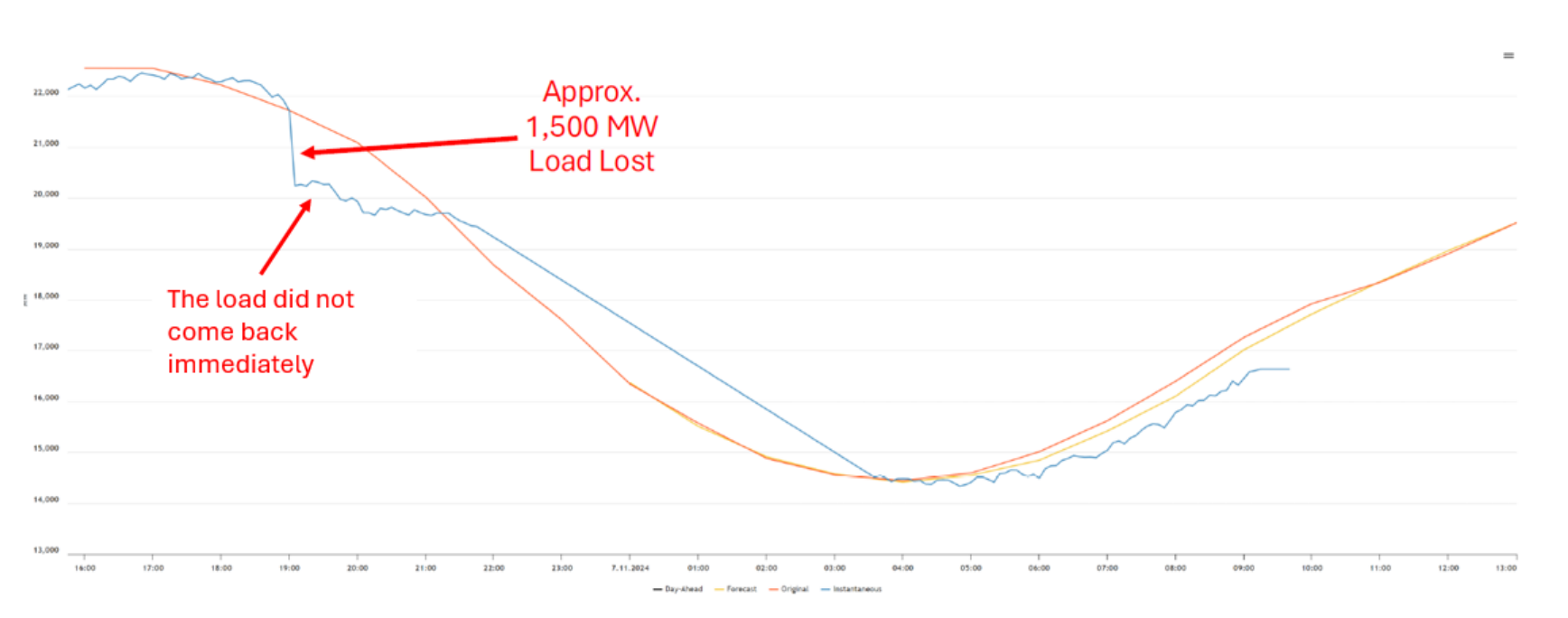
About 1,500 MW of load left the grid, all of it data center load. No utility equipment disconnected any of it: the data centers’ own protection and controls made the transfer. The largest step came with the third dip, matching the three-dips-in-a-minute counting scheme. NERC reports that about 1,260 MW dropped at that moment and did not return for hours. Frequency rose to 60.047 Hz, voltage rose to 1.07 per unit, and operators switched out capacitor banks to bring the voltage back down.
2025: the same failure, five more times
NERC’s Large Loads Working Group lists five more data center load-loss events in the Eastern Interconnection in the first half of 2025, in its draft white paper “Large Load Disturbance Performance”, posted for comment on July 30, 2026. On February 17, 2025, a fault on a 230 kV line produced four voltage dips and about 1,800 MW of data center load reduction across 18 substations. Service to those sites was never interrupted. Most of the reduction again came after the third dip. On May 3, 2025, three dips within about one second removed about 540 MW, most of which came back in 15 to 20 minutes. On June 19, 2025, about 1,300 MW left the grid.
July 22, 2026: 3,800 MW and an overvoltage second wave
PJM presented its preliminary review to its Operating Committee on August 6, 2026. A single conductor pulled free of its compression sleeve on a 230 kV line. All protection operated as designed, with no relay misoperation and no stuck breaker. The timeline in the review shows an initial load loss of 2,970 MW at 07:56:33. The transfer raised voltage across the area, and at 07:57:40 a secondary load loss of 1,099 MW followed. The total moved to backup power was approximately 3,800 MW.
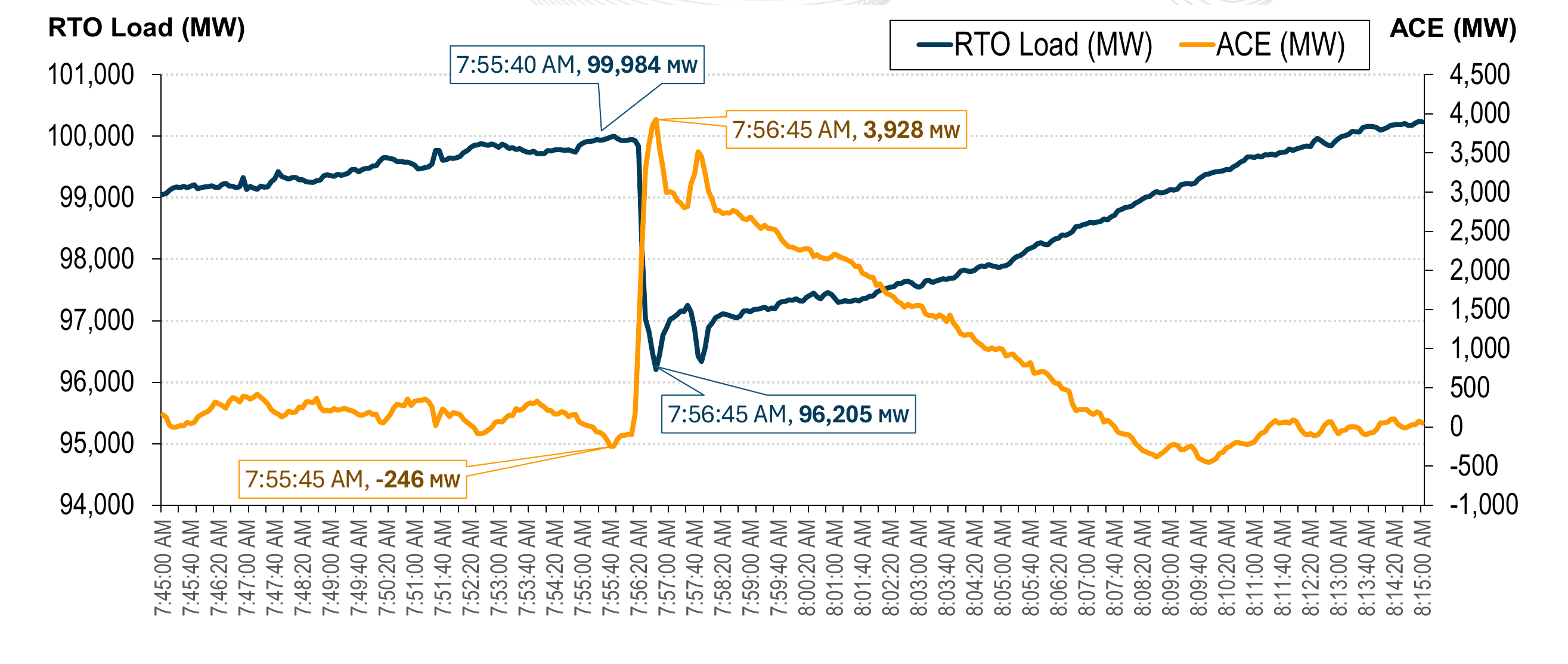
PJM’s system frequency rose to 60.092 Hz. PJM brought its control error back within limits in 9 minutes, inside the 30 minutes the NERC standard allows. Overvoltage relays tripped capacitor banks, operators closed reactors to pull voltage down, and the customers moved their load back to the grid within 30 minutes. PJM’s own conclusion is that the load transfer was likely due to voltage ride-through performance.
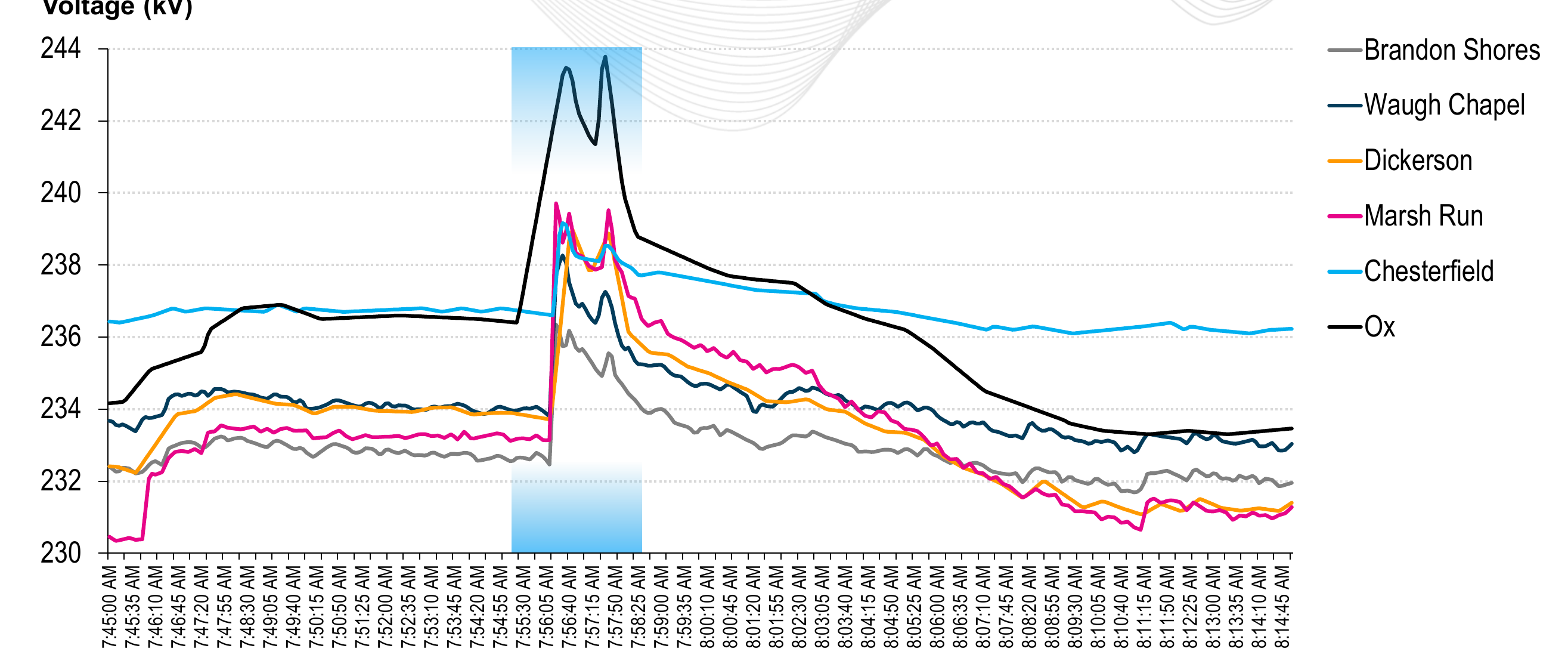
In the events NERC and PJM have reviewed, the transmission system cleared the fault as designed and the load loss came from the customers’ own controls.
Texas has seen the same behavior at smaller scale
ERCOT told its board in December 2025 that it had identified 26 events since the start of 2023 in which data centers or cryptocurrency mines tripped offline during normal voltage disturbances. The NERC working group paper counts 32 events of 100 MW or more in ERCOT from January 2023 to April 2026. ERCOT’s analysis finds that a simultaneous loss of 3.2 GW of load may pose a significant risk to frequency and voltage stability in its interconnection, and ERCOT has said it may curtail computational loads to keep a single event below that level.
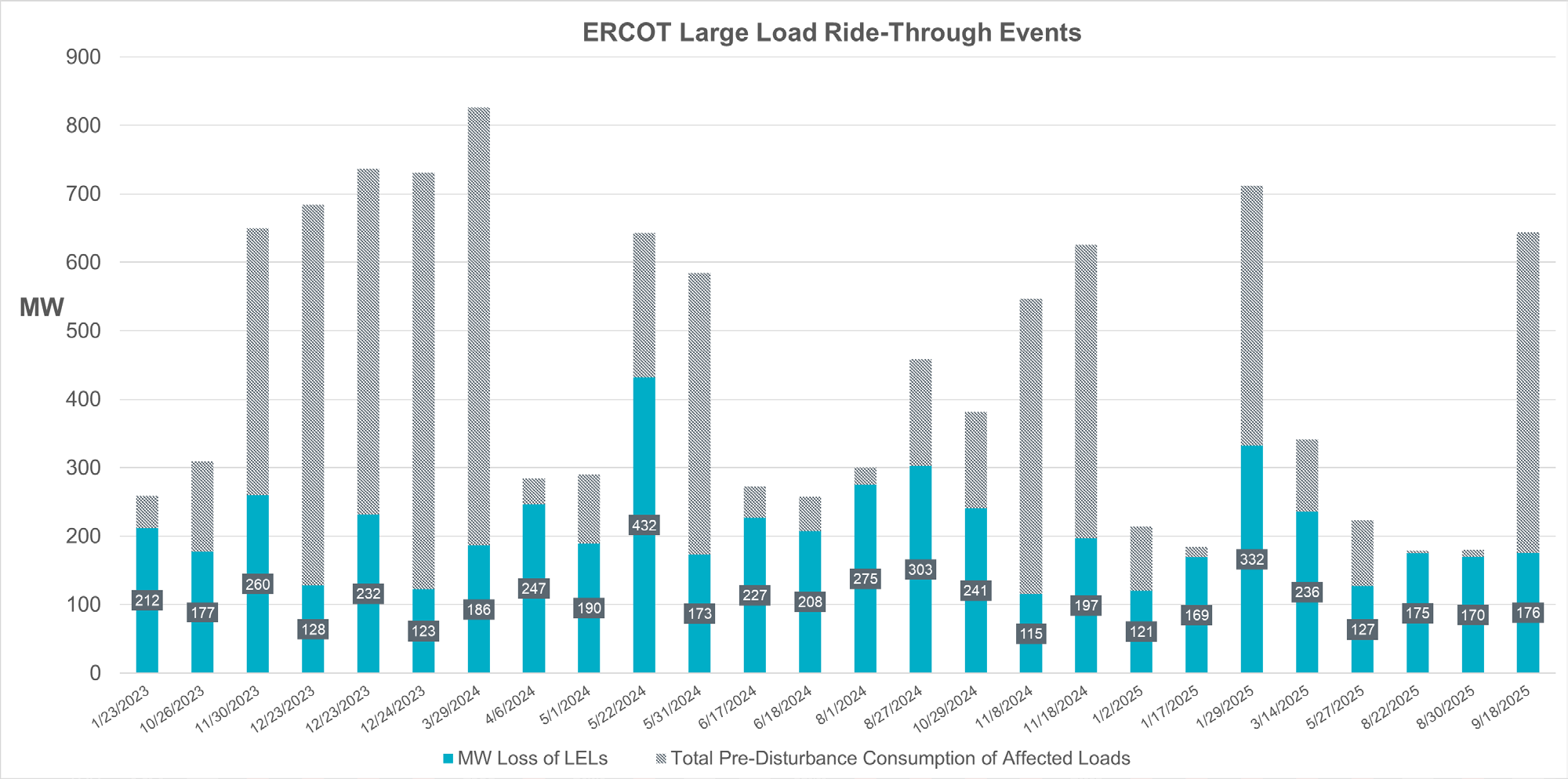
Most Texas events have been smaller, 100 to 450 MW each. The pipeline of new load changes that. ERCOT reported about 9 GW of large loads operational or approved to energize in April 2026, and about 410 GW of large-load requests seeking interconnection, roughly 87 percent of them data centers. PJM’s January 2026 forecast adds 65,733 MW to its summer peak by 2036, with growth in data center load named as the reason for the load adjustment in 14 of its zones. A fault that removes a few hundred megawatts today removes several gigawatts when the same area holds ten times the load.
What NOGRR 282 requires
NOGRR 282 applies to a Large Computational Load: a large load (75 MW and above under ERCOT’s rules) where at least half the demand is computational load, such as a data center or a cryptocurrency mine. The requirements sit in Nodal Operating Guide Sections 2.6.4 (frequency) and 2.15 (voltage). Loads that were energized, or had their interconnection agreements, funding and studies in place, by November 14, 2025 are exempt, as are some loads that energize by December 31, 2026 under a utility attestation. An exempt load that is later modified in a way that requires a new interconnection study loses the exemption. A pending revision request, NOGRR 289, filed on July 21, 2026, would give a load up to 365 days after its in-service date to bring its cooling load into compliance where chiller and drive equipment cannot yet meet the requirements.
Each provision answers a failure in the event record:
| Provision in Section 2.15 | What it requires | The failure it answers |
|---|---|---|
| Voltage envelope, Table A | Stay connected for 0.15 s below 0.35 pu, 0.25 s up to 0.50 pu, 0.5 s up to 0.80 pu, 2 s up to 0.90 pu, continuously from 0.90 to 1.10 pu, and 1 s from 1.10 to 1.20 pu | Normally cleared faults of 42 to 66 ms that removed 1,500 MW in 2024 |
| Return to the grid, paragraph (3)(c) | Back to at least 90 percent of pre-disturbance consumption within 2 s of voltage recovering above 0.90 pu | Load that stayed on backup for minutes or hours |
| Transfer schemes, paragraph (3)(e) | A site that transfers to its own backup begins returning within 0.25 s and reaches 90 percent within 0.5 s | Load that waited for a manual transfer back |
| Counting schemes, paragraph (7) | No trip or transfer based only on a count of sags or swells. Where equipment needs one, the site rides through at least six in 90 s | Three-dips-in-a-minute logic during the reclosing sequence |
| Overvoltage, Table A and paragraph (3)(a) | Keep consuming at the pre-disturbance level up to 1.10 pu, and stay connected for 1 s up to 1.20 pu | The 1,099 MW second wave of July 2026 |
| Failure, paragraph (8) | Root cause to ERCOT within 90 days, then a fix. ERCOT may disconnect a load that poses an imminent risk | Repeat events at the same sites |
The frequency side is set the same way. A load stays connected continuously from 58.8 to 61.2 Hz and for 299 seconds out to 57.5 and 63.0 Hz, keeps drawing current from the grid, and should keep its consumption within 10 percent of the pre-disturbance level while it does.
The rest of North America is moving in the same direction. NERC issued a Level 3 alert on computational loads on May 4, 2026, its highest level of alert, with essential actions on modeling, instrumentation and ride-through. FERC, in Docket RD26-7-000, has directed NERC to file reliability standards for computational loads by December 31, 2026. PJM told its Operating Committee that it is evaluating its own ride-through requirements.
Riding through at the medium-voltage level
In every event above, the load left the grid through the customer’s own backup equipment, which sits at low voltage inside each building and protects the computers by taking their load off the grid. NOGRR 282 asks for the opposite at the site’s service point. The load stays on the grid through the fault and returns its full draw within seconds.
A medium-voltage UPS meets both needs from one place. In a dual-conversion block the halls are fed by their own grid-forming converter, so a sag on the utility side never reaches them, and the grid-side converter returns the site’s draw after the fault clears. In a parallel connection the halls keep their own UPS, and battery blocks on the medium-voltage feeder take up the load the hall UPS is still carrying when voltage returns, so the site’s draw is back at its pre-fault level inside the recovery window. The Battalion medium-voltage UPS is fully compatible with grid-fault ride-through interconnection rules such as NOGRR 282. The scenario models for both connections, and the settings confirmed in each site’s interconnection study, are on the NOGRR 282 ride-through page.
For a site in ERCOT that is not exempt, ride-through is now a condition of connecting and of staying connected. Elsewhere, NERC’s first standards for computational loads are due at FERC by December 31, 2026. Bring the single-line diagram, the load profile with its time resolution, and the interconnection agreement. Request information to start that review.
Sources
- NERC, Incident Review: Considering Simultaneous Voltage-Sensitive Load Reductions, January 8, 2025.
- NERC Large Loads Working Group, Large Load Disturbance Performance, draft posted for comment July 30, 2026.
- PJM Operating Committee, July 22, 2026 load transfer event, August 6, 2026.
- ERCOT Board of Directors, Item 6.2: Large Electronic Load Ride-Through Requirements, December 8 to 9, 2025.
- ERCOT, NOGRR 282, Large Computational Load Ride-Through Requirements, approved July 9, 2026, effective August 1, 2026, and NPRR 1308.
- ERCOT, Large Load update to the Texas Senate Committee on Business and Commerce, April 1, 2026.
- PJM, 2026 Load Forecast Report, January 14, 2026.
- NERC, Level 3 Alert: Computational Load Modeling, Studies, Instrumentation, Commissioning, Operations, Protection, and Control, May 4, 2026.